
 English
 日本語
日本語
 한국어
한국어
 简体中文
简体中文
 繁體中文
繁體中文
 Italiano
 español
 Deutsch
 Русский


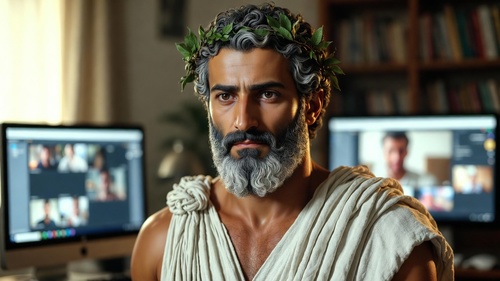
Have you ever wondered what the great thinkers of the past would make of our digital classrooms today? As someone who earned a PhD in Philosophy of Education, I often imagine ancient philosophers stepping into a modern online lesson. None fascinates me more than Socrates, the Athenian gadfly who famously claimed he knew nothing — yet spent his life asking questions that changed Western thought forever.
Socrates never wrote a single book. He taught in the marketplaces of Athens through dialogue: relentless, probing questions that forced his students to examine their own beliefs. His famous method, now called the Socratic method, was simple but powerful: “Tell me, what do you mean by justice?” “Why do you believe that?” “Can you give an example?”
Through this back-and-forth, people discovered gaps in their thinking and, ideally, moved closer to the truth. So, would Socrates have loved platforms like Cafetalk? I think he would have been thrilled by some aspects. Online one-on-one lessons mirror his ideal of intimate dialogue far better than large lecture halls or pre-recorded videos.
In a live session, a teacher can ask real-time questions, listen carefully, and guide the student to deeper understanding — just as Socrates did with his young companions in Athens. The chat box, the shared screen, the ability to pause and reflect — all these tools could serve the same purpose as walking slowly through the agora while talking.
Yet I suspect he would also have strong criticisms. Socrates distrusted writing itself (as Plato records in the dialogue Phaedrus), arguing that written words are dead, as they cannot answer back or clarify when misunderstood. How much more suspicious might he be of passive video lessons, PowerPoint slides, or AI-generated content that delivers information without true interaction?
He might say that real learning happens only when two minds meet in genuine conversation, not when one mind consumes content alone. For Socrates, education was never about memorizing facts or passing exams. It was about becoming a better person—more thoughtful, more honest, more courageous in facing what we do not know.
In our busy modern lives, many of us turn to online learning for practical goals (better English, higher test-scores, career advancement) but perhaps, we also crave something deeper: the chance to examine life itself. That is why I love teaching on Cafetalk.
My lessons — whether exploring Plato’s ideas, discussing the history of educational thought from antiquity to today, or simply having meaningful conversations about life — are built around dialogue. Like Socrates, I believe the best learning happens when we ask questions together and discover insights neither of us expected.
If you enjoy thinking deeply while practicing English (or German), I invite you to try a lesson. Who knows: Perhaps Socrates would join us in spirit and ask the first question. What do you think: Would the ancient philosopher approve of our virtual classrooms?


コメント (0)