
 English
 日本語
日本語
 한국어
한국어
 简体中文
简体中文
 繁體中文
繁體中文
 Italiano
 español
 Deutsch
 Русский



When you look at a map of Japan, there are places that feel like temporary stops, and others that feel like home. In nearly two decades here, my wife and I have lived in eight locations, and each move has carried its own story — and its own grammar.
This column explores that journey, and shows how tense helps us express:
change
habit
memory
and possibility
My wife and I have lived in several places in Japan, and each move seems to have its own tense. When we tell stories about the past, we rarely use just one grammatical form. We slip between used to and would, between have lived and had moved, between might move and could happily stay forever. Our language becomes a kind of map. The way we choose a tense shows how we remember, how we feel about change, and how we imagine the future. This is a story about where we have lived — and the tenses that naturally appear when we talk about it.
My wife and I met at university in the UK. After we graduated, she moved back to Japan, where she started working in a large company. A year later, she was sent to Hong Kong, and for several years, we used to travel back and forth, seeing each other whenever we had the chance. I was lucky. My father worked for British Airways, so I got cheap flights. It was actually at an airport that I proposed. A week later, we had our English wedding, and I moved to Japan to join her. I remember thinking: Japan might feel different, but it will be interesting — and I’m sure I will get used to it.
When I first came to Japan, about twenty-seven years ago, we lived in Osaka. At first, we stayed in my wife’s family home while we looked for an apartment in Dainichi. Between the station and the house, there was a gym doing a great deal, and every evening my wife and I would meet in the hot tub, talking about our day. It felt like a small luxury in the middle of our busy lives.
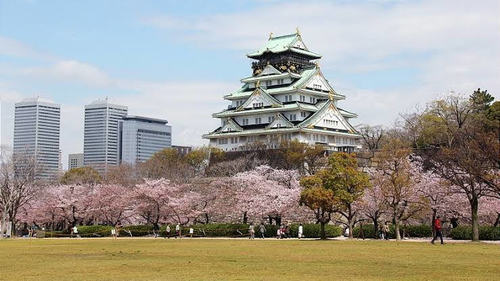
Later, we decided to live in Kyoto. We found an apartment in Demachiyanagi, next to the Kamo River, and I commuted to Osaka every day to teach. I had been commuting for about two years when we moved back to Osaka because her parents had already downsized to a smaller apartment. Those were late-finishing days. We often worked long hours, and we would occasionally meet in an izakaya — a little food, a drink, and a chance to catch up before heading home.
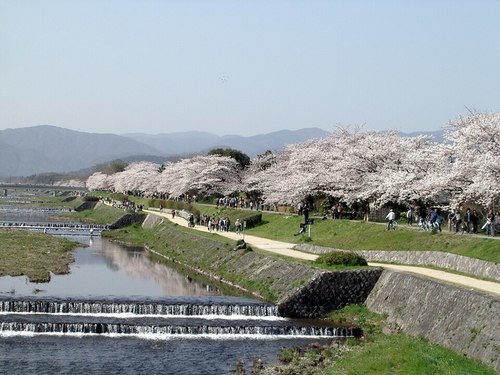
After six years in Japan, we returned to the UK. I trained as a musical instrument repairer, I taught yoga, and my wife worked in law. Looking back, I never expected to return to Japan.
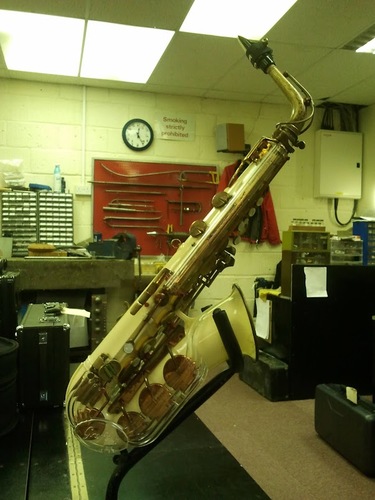
As my wife’s parents were getting older, we moved back to Japan about ten years ago. At first, we lived in Osaka again, but after a day trip around Lake Biwa, we fell in love with the area, so we moved to Shiga. At the time, I was teaching in Osaka, another long commute. When COVID arrived, we were sent out to more local schools, and suddenly, we were spending more time together. In the evenings, instead of the hot tub or the izakaya, we would meet at the lake — shoes in hand, watching the light change over the water.
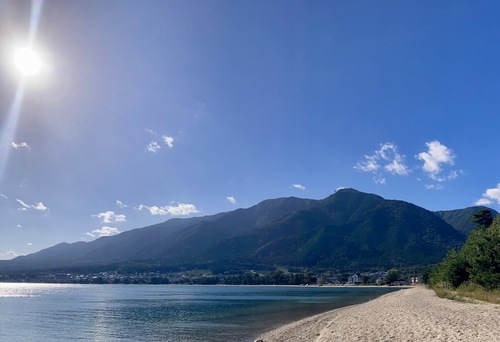
Work moved again, so we relocated to Tochigi. We stayed in Utsunomiya — gyoza city — for a year, before moving back to Kansai, this time to Kobe. A year later, we moved again, to Ehime in Shikoku, to run a dairy farm (see my first four colums about life on the farm).
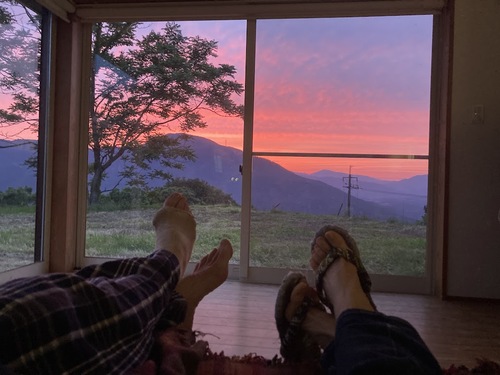
After a year on the farm, we returned to Shiga, only two minutes from the beach and ten minutes from where we had lived five years before.
For the foreseeable future, we are going to stay in Shiga. I started teaching on Cafetalk in July, and the work has already become part of our life here — the lessons, the conversations, the rhythm of daily life.
Shiga feels like home. We might move closer to Osaka someday, but whenever I look out of my bedroom window and catch a glimpse of sunrise over the lake, I feel that I could happily never move again. When there is a light dusting of snow on the Hira mountains, it is even harder to imagine leaving.
Learning Support
Past simple — completed action
moved back to Japan
Past continuous — background action
were spending more time together
have been content
Present perfect continuous — ongoing up to now
have been teaching on Cafetalk for several years now
Past perfect — earlier past
had already downsized
Past perfect continuous — ongoing before another past action
had been commuting for about two years
Used to — past habit
used to travel back and forth
Would — repeated past action
would meet in the hot tub
Going to — planned future
are going to stay in Shiga
Conditional — possibility
might move again someday
Prediction / uncertainty
perhaps we will move
Useful Collocations (short explanations)
catch a glimpse of – see briefly
light dusting of snow – thin delicate layer
fall in love with an area – become very fond of a place
long commute – long journey to work
feel like home – feel familiar, comfortable
small luxury – a simple pleasure
shoes in hand – walking barefoot while carrying shoes
Phrasal Verbs (natural everyday English)
travel back and forth – go repeatedly between places
look for – search
catch up – share news
head home – go home
move back – return to a place
run a farm – manage a farm
fall in love with – become fond of
Idioms / natural expressions
life has a way of surprising us – unexpected things happen
felt like ours – emotionally belonged to us
get used to it – become comfortable
time moves on – life changes
happily never move again – happily stay forever




コメント (0)