
 English
 日本語
 한국어
 简体中文
 繁體中文
 Italiano
 español
 Deutsch
 Русский


Suggested level: B1–B2
Reading time: About 3 minutes
Topic: An unusual English language fact
Imagine finding a new word in a dictionary. It has a spelling, a pronunciation and a definition. You would probably trust it.
But what if it got there by mistake?
Meet dord—a “ghost word” with a surprisingly simple explanation.
A word with no evidence
In 1934, Webster’s New International Dictionary, Second Edition included dord as a noun meaning density.
There was a problem: the dictionary’s records contained no examples of people using it.
So where had it come from?
The clue was on a piece of paper
Chemistry editor Austin M. Patterson had prepared a note about abbreviations for density:
D or d
He meant that either a capital D or a lowercase d could represent density.
Someone preparing the entry misunderstood the note. Instead of reading three separate parts—D / or / d—they treated them as one word:
dord
The dictionary-making process involved putting spaces between letters, which helps explain the confusion. A pronunciation was added, and the mistake passed through the remaining checks.
When did someone notice?
An editor discovered the error in 1939 and requested a correction. However, the entry was not removed until 1947.
One misunderstood note had created a dictionary word.
What is a “ghost word”?
A ghost word is a word recorded by mistake, often because someone misread or misprinted something.
It is different from an unfamiliar word. An unfamiliar word may have a perfectly ordinary meaning—you simply have not met it yet!
Dord’s problem was that the evidence behind its dictionary entry was missing.
Useful words from the story
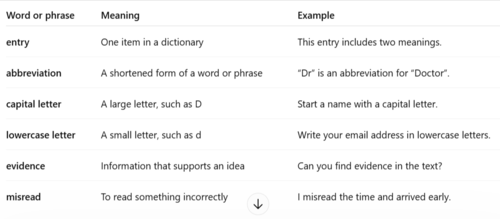
Check your understanding
Try answering before looking below.
-
What was “dord” supposed to mean?
-
What did “D or d” actually explain?
-
Was the mistake corrected as soon as it was discovered?
Answers
-
Density.
-
Either capital D or lowercase d could be used as an abbreviation for density.
-
No. It was discovered in 1939, but the entry was removed in 1947.
Your turn
Have you ever misread a message and understood something completely different?
Try describing what happened:
“I thought it said ______, but it actually said ______.”
Sometimes a small reading mistake creates a funny moment. In this case, it created a dictionary entry!




Comments (0)