
 English
 日本語
日本語
 한국어
한국어
 简体中文
简体中文
 繁體中文
繁體中文
 Italiano
 español
 Deutsch
 Русский


Inspired by a Japanese student struggling with Vietnamese final sounds, I developed a self-created, optimized pronunciation method based on the Hanoi accent, designed specifically for learners who fear or struggle with final sounds.
1️⃣ Learn Final Sounds Once, Then Combine Naturally
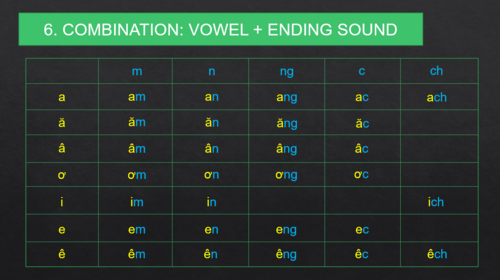
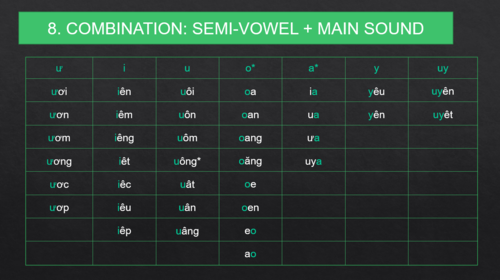
Instead of breaking sounds into steps like ên → iê + n, we keep the final sound you already know and simply add the preceding vowel or consonant. This makes pronunciation simple, logical, and surprisingly easy. It also works for combinations like ơc → ươc → nước. Although these sounds didn’t historically exist in Vietnamese, they are extremely useful for learners.
Below is two slides I personally designed to illustrate this method.
2️⃣ Logical and Intuitive Approach
Traditional textbooks avoid certain sounds not because they are difficult, but because they never existed historically. By treating these sounds as logical building blocks, students can master pronunciation faster and more naturally.
3️⃣ Optimized Learning Experience
I created structured PPTs with clear examples and exercises. Each lesson shows how to combine known final sounds with new initial sounds, so students apply them confidently and efficiently.
This method helps learners master Vietnamese final sounds quickly, accurately, and confidently, all in the authentic Hanoi accent—a truly original, practical, and optimized approach.





응답 (0)